Custom Gaskets, Seals and O-Rings
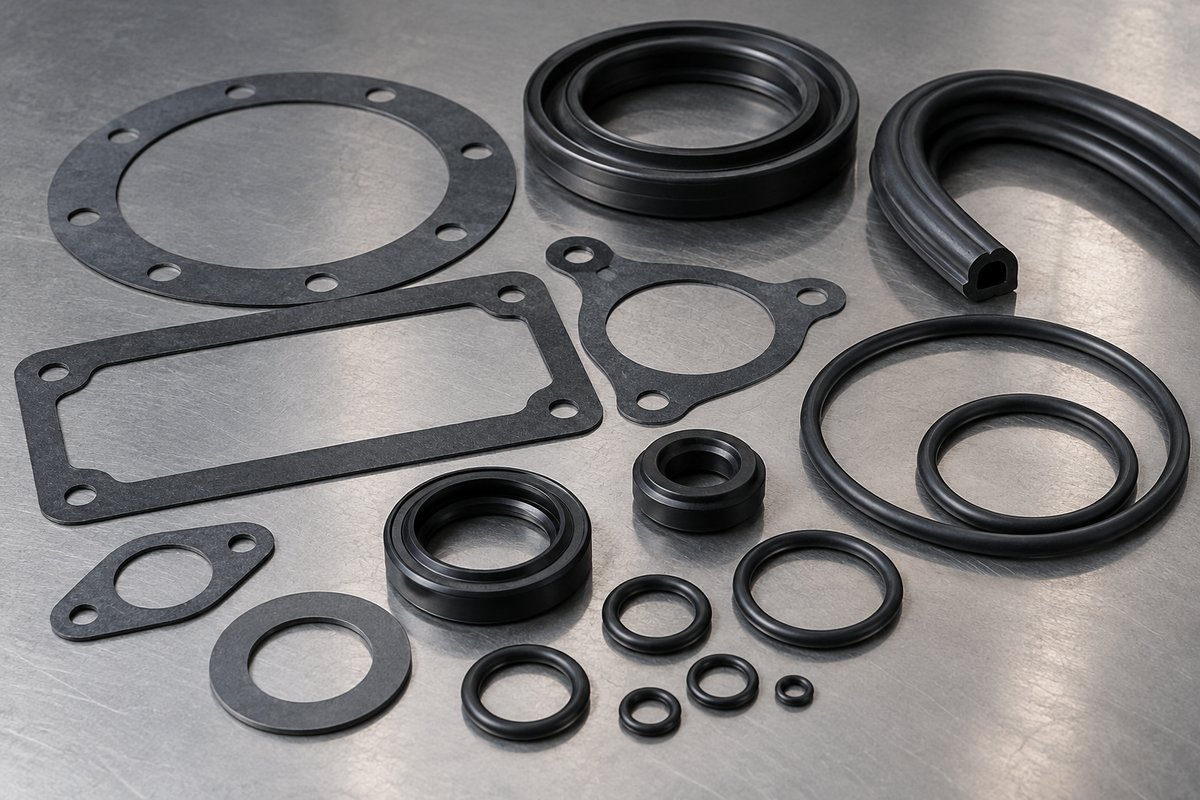
Gaskets and seals are the most common custom rubber parts. The right route depends on the shape: flat gaskets can be die-cut or waterjet-cut from sheet with no mold, while profile seals, O-rings and three-dimensional gaskets are molded.
Gasket and seal types
| Type | How it is made | Notes |
|---|---|---|
| Flat gaskets | Die-cut, waterjet or knife-cut from sheet | No mold for small quantities; die-cutting tool for volume |
| Molded gaskets | Compression or injection molded | 3D shapes, sealing beads, integrated features |
| O-rings | Molded | Standard sizes (AS568, ISO 3601, JIS B 2401) or custom |
| Grommets and boots | Molded | Cable and hose protection, dust covers |
| Extruded profiles | Extruded and cut or spliced | Door and panel seals; corners can be molded |
O-ring sizes and materials
Standard O-ring sizes follow AS568 (USA), ISO 3601 (international) and JIS B 2401 (Japan). Custom sizes are molded when a standard size does not fit. Common materials are NBR (oils), EPDM (water and steam), FKM (heat and chemicals) and silicone (wide temperature range, low friction loads). 70 Shore A is the most common O-ring hardness.
What to send
- Drawing with cross-section, inside diameter or outline, and tolerances
- Groove or mating-part drawing if available
- Material, hardness, operating temperature and media
- Pressure (static or dynamic seal) and any compliance needs
- Quantities
FAQ
Should my flat gasket be die-cut or molded?
Flat gaskets of uniform thickness are usually cut from sheet — no mold is needed for small quantities. Choose molding when the gasket has a 3D shape, sealing beads, varying thickness or very high volume.
Can you make non-standard O-ring sizes?
Yes. Custom O-rings are molded with dedicated tooling. Send the inside diameter, cross-section, tolerances and material.